
Thank you for volunteering to correspond with an incarcerated person. No letters you ever write will mean as much to their recipient as the messages you send into solitary. You may be one of only a few people on the outside of prison available to your correspondent.
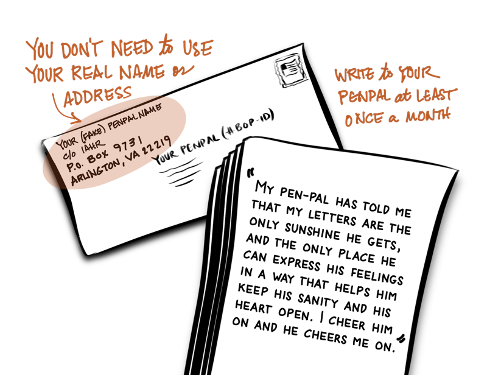
Because the letters you send are so important and powerful to the people who receive them, we urge you to keep up the correspondence, writing at least once a month. During especially busy times, a short note can take the place of a full letter, but longer letters are always greatly valued.
Because you are writing to an incarcerated person, there are many restrictions that apply to your correspondence. Some are prison rules, others are common sense. Please read the following carefully and abide by them throughout your involvement with the letter-writing program.
Regulations and recommendations
- Colored paper and greeting cards are not permitted. Use only white paper and envelopes and write on one side of the paper only.
- Write or type on one side of the paper only. Your letter should be no more than five pages.
- Envelopes must include a return address. You may use the address of your religious community for a return address, or the IAHR Pen Pal Address (below). Do not give out your home address or phone number.
- If you prefer not to use your name, please invent one, and let us know the name you have chosen. If you would like to use your name, please feel free to do so.
- Always include your correspondent’s corrections department ID number when addressing letters or they will not reach your pen pal.
- If you are unsure of your pen pal’s address or number, you can find it on the BOP website’s prisoner locator (https://www.bop.gov/inmateloc/). You can find a prisoner by either entering his/her number or his/her name. The locator will tell you the address of the prisoner and the date of his or her release.
- Do not use stickers, including return address stickers. In many states, they are not allowed.
- In your first letter, let your pen pal know that you received his or her name and address from Interfaith Action for Human Rights. Please explain that you would like to begin corresponding monthly.
- Some mailrooms deliver only the letter without the envelope, so be sure to include a return address in the body of your letter.
What to write
- Include some basic information about who you are in your first letter, your interests, why you wanted to participate in the letter-writing program, and how often you feel you can write. Ask them about their interests and what they like to think, read, and write about.
- The best letters are those that are personal and informative without being too intimate. People in prison enjoy hearing about news and ideas from the world outside. Write as if you were writing to an acquaintance, and later perhaps a friend.
- Be clear about your own limitations to create accurate and reasonable expectations about your correspondence. For example, you may wish to mention that you are not able to provide legal or other individual assistance to your correspondent.
- Please do not ask your correspondent what they “did”—i.e., what their crime was. People in prison are often defined by their crimes, but they are, in fact, much more than that.
- Avoid using terms like convict, inmate, and even prisoner. Incarcerated people are people and should be referred to as such.
- We advise against sending money to your correspondent or making donations to their commissary accounts.
- Please note that generally anything that you write to your correspondent, and anything your correspondent writes to you, can be read by prison staff. Please use your best judgment in terms of the content of what you write to ensure that you do not put your correspondent at any further risk of harm or retaliation.
FAQ
I haven’t gotten a reply from my pen pal. What should I do?
Allow up to a month to receive a response from your correspondent. Mail moves more slowly behind prison walls. Your pen pal might have been moved. You can find his or her new location by going to the website of the federal inmate locator: https://www.bop.gov/inmateloc/. If you have not received a reply after writing again, please email the pen pal coordinator, [email protected].
Your letter might also have been delayed if it was returned to the IAHR. This can happen if you use colored paper, include a greeting card, or forget to include your pen pal’s prison ID number when addressing your envelope. In these cases, the office staff will let you know, correct the error, and resend your letter.
I don’t have time to write a full letter to my pen pal, what should I do?
There is a paid service that will send a postcard to your pen pal to let them quickly know you are thinking about them. https://www.flikshop.com/. Note: some prisons are no longer permitting postcards.
Can I send my pen pal anything besides a letter?
We advise against sending just about anything else. You may think you are doing something kind when in fact you are sending in contraband that can get the recipient in deeper trouble. (Postage stamps, for example, cannot be sent into most prisons).
One possible exception to this rule is books and magazines, which are usually allowed, though often with restrictions (such as no hardcover books, or only books sent directly from the vendor, for instance Amazon). These can be welcome gifts if and when requested, and if sent in accordance with the rules in the specific prison where your pen pal is incarcerated.
I am no longer able to write to my pen pal. What should I do?
If for some reason you cannot continue writing to your correspondent, please notify the pen pal coordinator via email [email protected].
My pen pal asked me to forward a letter to a third party. Is this ok?
Never agree to forward a letter to a third party or contact someone on the outside on behalf of your correspondent.
My pen pal seems to be interested in a romantic relationship. What should I do?
If your correspondent suggests any kind of relationship that is not strictly platonic, please be kind but clear and firm in letting them know this is not what you are looking for.
My pen pal has asked me for legal assistance. What should I do?
Correspondents might ask for legal help or advice, or report ill-treatment or unjust placement in solitary. Unfortunately, there are few resources available to help with these kinds of issues. If you receive such a request, please contact our executive director. They may be able to refer the issue to someone who can help.
I’m uncomfortable with things my penpal has written. What should I do?
If anything about your correspondent’s letters makes you uncomfortable or concerned, please contact our executive director or the pen pal coordinator for advice.